Showing posts with label children's books. Show all posts

Monday, February 02, 2015

Hey wait, I thought I hated clowns!

The Farmer and the ClownThe Farmer and the Clown by Marla Frazee
My rating: 5 of 5 stars
Published by Beach Lane Books (Simon & Schuster, New York, 2014)

Okay, I have to get this out front - I really dislike clowns. I’ve always found them creepy and not a bit funny. But with this sweet and touching picture book, author/illustrator Marla Frazee has just but a small dent in my opinion of clowns. The little clown in her wordless picture book, who gets separated from his family when he falls off of their circus train, is probably the cutest clown ever. His simple makeup consists of a plain white face, a relatively small red nose and a painted-on smile. When he’s found and taken home by a stern-looking farmer and washes off his make-up, we see underneath a worried and sad expression - the look of a lost child.

This book is all about finding a home, learning to feel at home, and the very essence of what home is. It could just as easily be the story of a refugee taken in by strangers, or about the adoption of a child. However you want to look at it, it’s a sweet and charming book. Considering that this is a wordless book, the author does a wonderful job of developing her characters. The farmer starts off seeming very stern and no-nonsense. Just from the expressions the author/illustrator has given him, we can see he is completely perplexed by this strange little person in a clown suit. But after the little clown washes off his make-up, we see from the farmer's facial expression that he is concerned about this lost child who he has brought into his home. Over the course of just a few pages, we see the farmer, while trying to make the sad child smile, loosen up and develop an affectionate bond with this little person. Along the way, each of the characters learns something new from the other. The farmer teaches the little clown how to milk a cow, while the little clown teaches the farmer how to juggle eggs. The farmer appears to be learning that all work and no play can make for a very dull existence. Marla Frazee conveys so much feeling and understanding in her illustrations with just changes in the body language of her characters and their facial expressions. This book is a great example of how to tell a complex story with no accompanying text.

I love how Frazee has used a limited color palette for her delightful illustrations. The farmer seems to exist in a world of soft sepia browns and charcoal grays. The little clown, dressed in reds and yellows brings color into the farmer’s drab existence. The clown’s suit really pops against the monochromatic backgrounds. More color is brought into the story when the circus train returns, bringing greens, blues, soft purples and oranges into the palette. At the end of this story, I had the feeling that the farmer had been changed forever by the little stranger who briefly became part of his life. And of course, without giving away the ending, the last illustration shows that the farmer’s adventures may not be quite over.

This book brought a smile to my face (the first time any clown has ever done that!) and I found it sweet and touching. I highly recommend this one!

Illustration by Marla Frazee. The farmer approaches the little clown who has fallen from the circus train.

Illustration by Marla Frazee. Underneath his make-up, the clown is a sad, lost child.

Illustration by Marla Frazee. The Farmer tries his hand at juggling and the clown helps the farmer in the fields.

Illustration by Marla Frazee. A happy reunion, but the story is not quite over yet.


View all my reviews

Sunday, January 25, 2015

Dory Will Leave You With a Smile

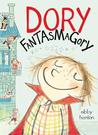
Dory FantasmagoryDory Fantasmagory by Abby Hanlon
My rating: 4 of 5 stars

The narrator of this funny and fast-paced story is six-year-old Dory (appropriately nicknamed Rascal) who has an active imagination and fills her days attempting to get her older siblings to play with her, conspiring with her imaginary monster friends, and trying to figure out ways to vanquish the child-snatching Mrs Gobble Gracker (an imaginary being her older siblings invent to try and scare Dory into being good). This is a cute book and author/illustrator Abby Hanlon successfully gives the reader a glimpse into the mind of a 6-year-old, reminding us of what it was like when fantasy and reality were intertwined and play was an integral part of our lives. With its profuse black and white illustrations, the book at times reads like a graphic novel and in fact many of the charming drawings have integrated dialogue bubbles. The illustrations, by the way, are delightful, filled with expression, action and funny details. This is a fast read and one that I think will delight young children and anyone who wants to relive those special years of childhood when playtime was ruled by imagination.

Illustration by Abby Hanlon. Dory is the cute little character on the far right

Illustration by Abby Hanlon. 

An example of how illustrator Abby Hanlon integrates comic book style word balloons into her illustrations
Illustration by Abby Hanlon. Dory gets a shot while on visit to the doctor.

Don't worry, the intended target of the dart is the imaginary Mrs. Gobble Gracker. Illustration by Abby Hanlon.


While on a time-out, Dory imagines her family is enjoying popcorn with her nemesis, Mrs. Gobble Gracker. Illustration by Abby Hanlon


View all my reviews

Tuesday, May 13, 2014

Mistress Masham's Repose


Mistress Masham's ReposeMistress Masham's Repose by T.H. White
My rating: 4 of 5 stars

Maria is shown the tiny livestock
illustration by Fritz Eichenberg
The premise of Mistress Masham’s Repose is a clever one - the travels of Lemuel Gulliver described in Jonathan Swift’s “Gulliver’s Travels” actually took place and some Lilliputians, captured on a later expedition, have escaped and have been hiding out and living in exile on a rundown English estate.  For over a century, they have managed to avoid detection by living inside of a garden folly. Their secret comes close to being exposed when they are discovered by Maria, a young girl living on her ancestor’s estate. For me, the best parts of the book were in White’s descriptions of how the tiny Lilliputians are forced to cope in a land of gigantic threats. The writing is often somewhat dense, but filled with humor and White shines in describing the foibles of his characters. The character of Maria is not always likable but White uses her to show how a little power can corrupt even a person with the best of intentions. As is often the case, the villains of the story are often the most interesting characters and White has created a devious pair in the characters of Maria’s governess, Miss Brown and Mr. Hater, a greedy Vicar. There is a lot of suspense created when these two conniving schemers discover the existence of the Lilliputians and plot ways to make a fortune off of them. They even discuss murdering Maria if it should become necessary to achieve their gains. White fills the book with doses of English humor (which may go over the heads of some younger readers) and frequently goes off on rather esoteric tangents, which I felt slowed down the narrative. If it weren’t for these esoteric and wordy asides, I probably would have given this book 5 stars. All in all, it’s an enjoyable read, especially if you’re in the mood for a story rooted in a classic of English literature. If you can, make sure and find an edition that contains the fantastic illustrations by Fritz Eichenberg. His amazing pen and ink work perfectly captures the humor and drama in White's story.

All illustrations are by Fritz Eichenberg and were scanned from a 1946 copy of Mistress Masham's Repose by T.H. White, published by G.P. Putnam's Sons.

The book has recently been reprinted by The New York Review Children's Collection.


Click on the illustrations to see them larger.

Miss Brown and Mr. Hater poke a captured Lilliput

Miss Brown discovers the People in Maria's room
The Professor and the People try to figure out
a way to release Maria from the dungeon


Some of the dangers faced by a
person who is only six inches tall.


View all my reviews

Sunday, December 29, 2013

My Favorite Picture Book of 2013

Mr. Tiger Goes WildMr. Tiger Goes Wild by Peter Brown
My rating: 5 of 5 stars

I first became aware of author/illustrator Peter Brown with his lovely picture book from 2009, “The Curious Garden.” I’ve followed his output ever since and with his latest book, “Mr. Tiger Goes Wild,” he has become one of my favorite author/illustrators. Using minimal text in combination with his wonderfully mid-century style illustrations, Brown manages to tell a surprisingly complex tale of bucking the norm and being true to oneself. Mr. Tiger lives in a society of animals that dress in human clothes, walk upright and are rigidly formal in their polite behavior. But for Mr. Tiger, always being prim and proper is a boring way to live. One day, he has a wild idea - he decides to walk on all fours! Right away he feels better, but when he decides to shed his clothes and run wild, his friends lose their patience and ask him to take his wild behavior to the wilderness. Without spoiling the ending, I will say that I found the resolution of this fun tale to be a delightful surprise.
illustration by Peter Brown from "Mr. Tiger Goes Wild"

The double-page spread where Mr. Tiger decides to shed his clothes is ingenious in its design and simplicity. A large public fountain forms the center of the two-page design (see last image at bottom). On the left page we see Mr. Tiger diving into one side of the fountain fully clothed. On the right page, we see Mr. Tiger emerging from the other side of the fountain but this time, without his clothes. Then we notice his clothes floating on the water. Turning the page, we see Mr. Tiger, standing on all fours, without a stitch of clothing to hide his magnificent striped coat. There is no text, words are unnecessary. His stance and the smile on his face tell us everything we need to know - Mr. Tiger has at last discovered his own true nature.

In this beautifully designed and humorous book, Brown presents the reader with a thought-provoking array of concepts - the stagnation of conformity, the joy in being different, respect for the rights of others, and making compromises. I highly recommend this book, definitely my favorite picture book of 2013!


detail from Peter Brown's "Mr. Tiger Goes Wild."


Double-page spread from "Mr. Tiger Goes Wild."


View all my reviews

Monday, October 07, 2013

Doodler Doodling by Rita Golden Gelman
My rating: 5 of 5 stars

Rita Golden Gelman has taken a simple concept - a daydreaming girl doodling on her notebook paper during class, and turned it into a fun, tongue-twisting page-turner filled with great word play and escalating situations. The author is helped by Paul O. Zelinksy’s wonderfully zany illustrations. Zelinksy is one of the most versatile illustrators working today. His illustrations for this book are nothing like the Flemish style renaissance paintings he created for Rapunzel. Here he combines loose watercolor and ink drawings to create dazzling doodles that come to life as the girl’s daydreams get out of control. The story and illustrations climax with a double-page fold-out. This is a fun book that would make a wonderful read-aloud and the pictures are so much fun that kids will want to study them over and over again to see how they relate to the playful text.


View all my reviews

Friday, June 21, 2013

Open This Little BookOpen This Little Book by Jesse Klausmeier
My rating: 5 of 5 stars

What Jesse Klausmeier’s “Open This Little Book,”  lacks in plot, it makes up for in cleverness and creativity. This is one of those books that is so clever in its concept that I found myself thinking, “I wish I had thought of that.” Klausmeier and artist Suzy Lee have come up with a book that makes the page turn an exciting event and have so smartly integrated it into the book’s concept that this is one book (like a pop-up book) I can’t imagine ever working on a Kindle. Part of the genius of this book is the change in page/paper size as the book unfolds. The title page itself is smaller than the page that comes before it and each page after that gets physically smaller until you get to the middle of the book where the pages start getting larger again. Now this may not seem like a stroke of genius to you, but the author and artist have brilliantly combined this size-changing concept with a simple series of events that will teach kids about size relationships, colors, animals, patterns and the joys of reading. One thing that I didn’t even notice on my first read was that the color palette changes as the story goes along. Each turn of the page adds another new color until the reader gets to the final illustration where the reader is rewarded with a beautiful illustration that uses the entire rainbow spectrum of color that we’ve been slowly introduced to. Suzy Lee’s illustrations, which in a few places remind me of William Steig, are charming and the last illustration in the book is so delightful, it gets my vote for best children’s book illustration of the year! This is a really clever and fun book.


View all my reviews

Sunday, June 09, 2013

Brave Girl: Clara and the Shirtwaist Makers' Strike of 1909Brave Girl: Clara and the Shirtwaist Makers' Strike of 1909 by Michelle Markel
My rating: 4 of 5 stars

This non-fiction picture book by Michelle Markel is a fascinating and important look at an era of America’s history that saw the rise of the labor movement and life-saving changes in worker’s conditions. Told through the eyes of young Clara Lemlich, a recent immigrant who finds work in the garment industry, this is a story of one young girl’s struggle to make a difference in the world. With her father unable to find work, it’s up to Clara to help support the family. When she gets a job stitching blouses in a garment factory, her eyes are opened to the unsafe and unfair working conditions that women (and men) of the day were forced to endure. For example: if you pricked you’re finger and bled on the cloth, you were fired; if you were a few minutes late you lost half a day’s pay; the doors were locked and every night the workers were searched to make sure they hadn't stolen anything; three hundred girls had to share two toilets. Disgusted by these unfair practices, Clara urges the other girls to fight for their rights. This is a book about standing up for what you believe in, not backing down and showing the courage of your convictions. These are lessons that shouldn’t be forgotten and are as important today as they were one hundred years ago when this story takes place. The story is beautifully complimented by Melissa Sweet’s mixed media illustrations that combine watercolor and gouache with collaged and stitched pieces of cloth and torn paper.


One of Melissa Sweet's mixed media illustrations


View all my reviews

Friday, June 07, 2013

A Little Book of Sloth

A Little Book of SlothA Little Book of Sloth by Lucy Cooke
My rating: 5 of 5 stars

If you’re not yet a member of the Sloth Appreciation Society, you will be after reading this adorable non-fiction book by Lucy Cooke that immerses readers in the world of orphaned and injured sloths. Filled with sweet photographs that are guaranteed to make even a curmudgeon smile, you’ll learn fascinating facts about the Bradypus or three-fingered sloth with their Mona Lisa smiles and their two-fingered cousins, the Choloepus who, according to the author, look “like a cross between a Wookie and a pig.” One of the things I learned  from this book about these adorable creatures is that sloths, unlike other mammals, can not regulate their body temperature. Consequently, sloths, like reptiles, need to bask in the sun in order to warm up. I also didn’t know that sloths are slow and slothful due to their diet. Cooke informs us that in the jungle, they eat slightly toxic leaves which don’t give them much energy. Because it takes them four weeks to digest a meal, they need to take it easy to stay free from painful indigestion. As fascinating as all of these facts are, I think the main attraction to this book, at least for kids, will be the adorable photographs of Buttercup, Wally, Honey, Sunshine, Sammy, Velcro and the other cute sloths that fill these pages with their cuddly personalities and sweet smiles.

Below are some of Lucy Cooke's photographs from "A Little Book of Sloth."

Mateo with his plush toy, Mr. Moo
Sunshine and Sammy
Baby sloth in a special onesie


View all my reviews

Thursday, June 06, 2013

Dream Friends

Dream FriendsDream Friends by You Byun
My rating: 3 of 5 stars

In "Dream Friends," artist You Byun’s debut picture book, a lonely girl named Melody has a special friend. As you may have guessed from the book’s title, the catch to their friendship is that Melody and her friend can only meet in her dreams. It’s an idea filled with promise and Byun has beautifully captured a child’s surreal dream world in her muted pastel colored paintings. With their slightly over-sized, bean-shaped heads, the character design in “Dream Friends” reminded me of the children in the animated film “My Neighbor Totoro,” (Melody's large dream friend, is also not unlike Totoro). The story itself is very simple and half of the book consists of scenes of Melody romping with her Dream Friend in their dream world. I do wish there was more development of Melody's character, but seeing that this book is meant for very young children, it's understandable that story and character development are secondary to the lovely illustrations. Even though the story may seem simple, the book does deliver a heartfelt message. In the end Melody learns that by taking inspiration from her dreams, she can find happiness, magic and friendship in her waking life. I suppose it's a lesson even grown-ups can learn from.

Below are two of the dream vignettes featured in You Byun's picture book, "Dream Friends."


View all my reviews

Thursday, November 29, 2012

House Held Up By Trees

House Held Up by TreesHouse Held Up by Trees by Ted Kooser
My rating: 5 of 5 stars

Ted Kooser’s beautiful history of a house is in someways reminiscent of Virginia Lee Burton’s “The Little House,” but unlike that book, Kooser doesn’t anthropomorphize his house or try to imbue it with human feelings.

In telling his story of a house from the time when it was new to its rebirth as a house held up by trees, Kooser, a former U.S. Poet Laureate uses language that is evocative but at the same time wistful. Like in Burton’s “The Little House,” the house in this story is the main character, the humans are secondary and they come and go. In the beginning we see the house when it is new, being cared for and loved by a man and his two children. Set in a clearing between two wooded lots, the house’s owner keeps the grounds immaculate, uprooting any seedlings that pop up in his perfect lawn. But as the years pass, the children move away and eventually so does their father. Sitting unsold, the house falls into disrepair. As time passes, seedlings and saplings pop up around it, hugging the house and protecting it from the winds. One day the trees, whose roots and branches have held the house together, begin to lift the house up toward the sky, where it is reborn as a house held up by trees. Jon Klassen’s digital and gouache illustrations are the perfect compliment for this somewhat melancholic story. Many of the illustrations are double-page spreads that give us wide panoramic vistas that emphasize the house’s isolation in the landscape. In two spreads early in the story we see the house as it looks from the point of view of the woods. We glimpse it through tree branches and see it sitting in the distance. It’s a clever foreshadowing of later illustrations where we will once again see the house through tree branches, the difference being that in the later illustrations we are up close to the house, with it looming large in the frame and the trees we are looking through are the ones that “held it together as if it was a bird’s nest in the fingers of their branches.”

As I mentioned, there are human characters in the story, but we never learn their names. We get glimpses of them from a distance or from behind, but we never see their faces. There are several haunting illustrations in this story that tugged at my heartstrings. In one, the two now grown children are shown from behind looking at the woods next to the house, a place where they use to run and play. It’s also a place where they would sit in the shadows and watch their father as he worked on his lawn. On the left side of the illustration are the woods, cool and inviting and unchanged from their childhood. On the right side, we see the adult children, the man holds a baseball cap at his side, while the woman holds a leaf. For me, these two details - a baseball cap and a leaf convey the melancholy of growing older. The only thing we can hold on to from our childhood are our memories and a few small mementoes, we must let go of everything else.

In another panoramic illustration, we see the father sitting in a folding chair, watching the sunset. The text tells us he is older now and his grown children "were gone for good . . ."  Next to the father, is an empty chair. On the left side of the spread we see through a window into the house's dining room where we get a glimpse of a lone place setting. Leaning against the outside of the house is the man’s lawnmower. Tall grass is starting to grow around it and even without the information in the text, we know that the man has given up on trying to keep up his lawn. It’s an illustration suffused with loneliness.

I loved this book. It was published by Candlewick, a publisher that seems to strive to put out beautiful books. This one is no exception. The language, illustrations and story are all beautiful. Having said that, I was somewhat surprised to see a publisher put out a children’s book that has no strong characters for children to identify with. It seems very much a book that will appeal more to adults looking back wistfully on their lost childhoods, then it will to most children. Maybe that's why I liked it so much. But I do hope that children will read this and love it. Those who do will be rewarded by a book that demonstrates the passage of time and what it means to grow older. Though there is a tone of loneliness in the book, there is also a comforting message of rebirth. I checked this book out from our public library, but it’s one that I fell in love with so I know I’ll be buying a copy for myself.

The illustrations below are by Jon Klassen from Ted Kooser's "House Held Up By Trees."

One of the panoramic two page spreads showing the house near the forest
Detail showing the house as it looks from the woods
A detail showing the father sitting alone on his perfect lawn

The now derelict house, sits alone, but the saplings are starting to surround it.


View all my reviews

Thursday, November 08, 2012

A Bus Called Heaven

A Bus Called HeavenA Bus Called Heaven by Bob Graham
My rating: 5 of 5 stars

Stella lives in the city. When an abandoned bus with a sign taped to it reading “Heaven” appears one morning in front of Stella’s house, people in the neighborhood seem to change. For once, they stop and talk to one another. Stella, who usually has her thumb in her mouth, changes as well. She sees potential in the old bus and before you know it, she has inspired her community to clean it up and turn it into a neighborhood club house where all are welcome. Everyone brings something to donate to their new community center - one little girl brings her goldfish, a little boy donates his comic books, Stella contributes her table soccer game, other people bring chairs, rugs and baked goods. One little girl loans her dog for people who just need to sit and pat something. This is a really sweet and delightful story of how a diverse neighborhood of people are able to work together for the betterment of their community. Author/Illustrator Bob Graham shows people of all ages, colors and creeds uniting to create a shared space where children can play (and fight), babies can crawl, people can laugh, granddads can scratch dogs, couples can meet, and families can show their vacation pictures. But this bit of heaven does face a crisis. When a junkyard man shows up with an order to remove the illegal vehicle, the community must figure out how to save it. I don't think it's a spoiler to say that Stella saves the day (and the bus!). The illustrations in this book are delightful - double paged spreads and pages with multiple illustrations are crammed with details. Cars and trucks, people of all shapes and sizes, dogs, birds, cityscapes, ships, and factories, houses and junkyards fill the pages and demand repeated viewings. A wonderful book about inclusion and working together to create a community.

View all my reviews

Wednesday, October 31, 2012

Creepy Carrots!Creepy Carrots! by Aaron Reynolds
My rating: 4 of 5 stars

What’s a poor rabbit to do when the carrots he loves to munch on begin stalking him? Jasper Rabbit is faced with that question when he begins to suspect the delicious carrots from Crackenhopper Field are following him around, spying on him as he brushes his teeth and watching him while he’s in bed. Author Aaron Reynolds and illustrator Peter Brown have created a child-friendly homage to a classic ‘Twilight Zone’ scenario in this funny picture book that is perfect for any young child looking to be scared, but not too scared. Illustrator Peter Brown, using a monochromatic palette of warm grays and carroty orange, captures the shadowy look of an old horror movie. Even the edges of the frame are rounded to suggest a story unfolding on an old television screen. Jasper Rabbit’s paranoia is cleverly conveyed in Brown’s illustrations where the artist shows us what Jasper sees (creepy carrots everywhere) and what others see (everyday orange objects like flower pots or pop bottles). Because no one else can see the creepy carrots, Jasper realizes that he must turn to his own resourcefulness to outwit them. Kids may not look at a carrot in the same way after finishing this funny, slightly spooky tale. This would be the perfect read-aloud for Halloween or any night when a scary tale is called for.


View all my reviews

Tuesday, October 02, 2012

Hit the Road, Jack

Hit the Road, Jack by Robert Burleigh
My rating: 4 of 5 stars

I've been a fan of Ross MacDonald's picture books since "Another Perfect Day." His retro style, done in watercolor and pencil crayon, is filled with a warm yellow glow, that looks like sunshine hitting paper. "Hit the Road, Jack" celebrates life on the open road and the joys of traveling cross country and was loosely inspired by Jack Kerouac's "On the Road." Author Robert Burleigh gives us a jackrabbit named Jack who is itching to travel and to see America. Setting out in New York he walks, bikes, hitchhikes and rides the rails from sea to shining sea, where he finally lands in San Francisco. But for Jack, the city by the bay is just one more stop, because for guys like Jack there's only one rule: "Never, Never Stop."

"Hit the Road, Jack" cleverly exalts the world of roadside diners, tourist attractions and taking the time to appreciate our country's beautiful scenery. My only complaint about this otherwise wonderful picture book is that some of the cities that Jack passes through look a little too generic. For example, when Jack lands in Chicago, we see him on South Halsted Street, but with the exception of a few jazz club signs, the buildings lack any real detail. The skyscrapers in the background could be from any big city. The text frequently mentions places that Jack is passing through, but instead the illustrations give us depictions of Jack having a picnic or sleeping in a car. Now, as an illustrator myself, I don't believe an illustrator's job is to literally interpret every word of the text, but I do feel that some of MacDonald's choices seem a little simple and generic. The illustrations are warm, funny, colorful and wonderfully composed, but I do think on a few occasions MacDonald missed an opportunity to do something spectacular. For example when Jack passes through the salt flats the text reads, "Over the salt flats, on and on, The horizon thick with reds, And mesas looming far, far off, Like carved-out giants' heads." The illustration shows Jack running across white ground with his arms upraised to the sky. In the background are a line of reddish-orange mesas which don't appear to be looming, nor do they resemble the giants' heads described in the text. Instead, they look small and insignificant and just don't convey the grandeur of these magnificent natural wonders.

On the whole the pictures and text depict an America of the past, a nostalgic 1940s America where strangers wave to one another, walking the streets was a safe thing to do, and hopping a freight and hitchhiking were inexpensive ways to travel. In this rosy colored world, money is not important "You're broke - but well, so what? 'Cause money's only something, Jack, That gets you in a rut." If only life were so simple.

I love to travel and I love road trips so I recommend this book for it's message of throwing your cares to the wind and seeing the world, even if in real life, that's not always the easiest thing to do. But, after all this is a picture book and kids need to know there's a beautiful world out there, waiting for them to explore it. Robert Burleigh's story conveys that message in a colorful way and kids will love searching MacDonald's illustrations for the little blue bird that follows Jack on his cross country travels. For adults, I think parents will enjoy the rhythms of the delightful text which is perfect for reading aloud.


Detail from "Hit the Road, Jack" illustration by Ross MacDonald

Detail from "Hit the Road, Jack" illustration by Ross MacDonald
View all my reviews

Tuesday, September 18, 2012

The Secret of the Stone Frog

The Secret of the Stone FrogThe Secret of the Stone Frog by David Nytra
My rating: 5 of 5 stars

A building comes to life
TOON Books is dedicated to bringing the world of graphic novels to a younger audience. They have produced some wonderful books including the “Benny and Penny” series by Geoffrey Hayes, “Stinky” by Eleanor Davis, “Little Mouse Gets Ready,” by Jeff Smith and “Zig and Wikki in the Cow,” by Nadja Spiegelman and Trade Loeffler. The books are beautifully produced and feature art by some of the finest illustrators working in the field of comics and graphic novels. This one, written and illustrated by newcomer David Nytra is a stunner. Nytra’s black and white art, reminiscent of Winsor McKay’s “Little Nemo” comic strip from the early 20th century is incredibly detailed and full of surprises. The story starts off and ends in a child’s bed but whether what falls in between is a dream or not is left for the reader to decide. When two young children, Leah and Alan wake up in the middle of the forest, they are told by a talking stone frog how to get home. But their mysterious guide also gives them a warning: “Stay on the path!” Anyone who is familiar with the lore of fairyland knows that strange things can happen to those who stray from the path. It’s not a spoiler to tell you that it doesn’t take long for Leah and Alan to be tempted off the path, and yes, very strange things do begin to happen. They meet giant, fuzzy bees who steal words, a trio of foppish lions, giant rabbits, and some bizarre denizens of the deep sea, who ride a subway dressed in suits and top hats. Besides the aforementioned “Little Nemo,” the book’s surreal episodes also have the feel of Lewis Carrol’s “Alice in Wonderland.” This is a book I think kids will want to read over and over again. The fantastic illustrations by themselves are enough to keep readers coming back for repeat viewings. I loved this book!

View all my reviews